Advertise

Advertisement

Search This Blog

 
Showing posts with label Animals. Show all posts
They’re a diabolical nuisance, yet considered sacred.  But for a gang of monkeys making their home at the Galta Temple in the Indian city of Jaipur, it’s an easy life — lounge by the sacred pool, groom your friends and accept handouts from worshippers paying respect to the Hindu Monkey God Hanuman.  But their happy days may be numbered.  When a lingering drought threatens local food supplies, the monkeys face an end to their easy gravy train. 
Join this charismatic fuzzy-haired crew as they search for food and find trouble on the chaotic streets.  When their quest for an easy meal goes awry, the temple troop finds life is harder away from home as they encounter monkey catchers, livid locals and bigger, badder monkeys. See how people cope with an army of troublemakers even as the monkeys contend with the official monkey catcher and rival bands of monkeys.
Throughout the series, Rebel Monkeys highlights the group’s ever-widening antics and the threats they encounter at their sacred temple home and across the big city.  Watch a battle of wits and reflexes play out as the local monkey catcher attempts to apprehend any macaque that crosses the line, to be carted out to the countryside miles from their urban paradise.
Read more...

Arctic Animals

Arctic animals are animals that have adapted physically and behaviourally to the particular conditions of life in the most northerly region of Earth. The Arctic can be defined in various ways. Geographically, it is that part of the world lying north of the ARCTIC CIRCLE (66° 32´ N lat) beyond which there is at least one day in the year in which the sun never sets and one in which it never rises.
Ecological definitions invoke the major discontinuities: on land, the major break is the TREELINE; in the sea, it is where the characteristically cold, low-salinity arctic waters meet Atlantic and Pacific waters in zones of upwelling and mixing. Typically, the lives of terrestrial and aquatic members of the arctic fauna are closely linked. The sea provides a food source for land birds (from snow buntings to whistling swans) that forage in spring on seaweed windrows on storm beaches; winter ice provides access to marine life for arctic foxes, wolves and POLAR BEARS. Conversely, many marine animals (from murres to walrus) use parts of the land for mating and raising young; others, such as ringed seals and ivory gulls, can raise their young on ice and thus be independent of the terrestrial environment.


Arctic Wolf


Wolves vary in colour from almost white in the Arctic to yellow-brown or nearly black farther south (Corel Professional Photos).


Limiting Factors


The arctic land fauna resembles more familiar faunas of the northern temperate zones; fewer species are present, but they are generally of the same orders and families as those farther south. The deficiencies arise for several reasons. On land, mean annual temperatures are below freezing and the ground remains frozen at depth; therefore, no warm layer persists near the surface through the winter. Hence, reptiles and most hibernating mammals are not found north of the line of continuous PERMAFROST. Because trees are absent, certain boreal-zone insects, rodents, carnivores and birds that depend on them for food and shelter disappear. Open water is scarce in most of the Arctic throughout most of the year. Except where rapids and tiderips occur, solid ice or dense pack generally forbids access to the aquatic environment. Animals wintering on the arctic TUNDRA must quench their thirst with snow. Fish-eating birds and mammals typically migrate for the winter to areas providing better access to prey; the remainder concentrate at the scattered polynyas (ice-free refuges).
The characteristic that most restricts opportunities for animal life may be the brevity of the arctic growing season. The land vegetation produced in the few but long days of the arctic summer must sustain life over an extended, harsh and demanding winter. It is hardly surprising that the most mobile animals pass the winter elsewhere: birds on ocean coasts farther south and in interior plains and forest lands; and many barren-ground CARIBOU on lichen pastures of the open BOREAL FOREST.
The short growing season tends to squeeze certain species out of arctic ECOSYSTEMS entirely. Beyond the edge of the barrens, it is rare to encounter the plagues of blackflies inevitable in the boreal forest. The absence of bats and swallows might be attributed to the very short period in which flying insects are available as food.
Another serious constraint is the dangerous heat loss caused by low winter temperature and high windchill. This factor imposes on warm-blooded animals the need for a thick, dense, insulating coat, which means that surface-wintering arctic animals must generally be large. The larger the animal, the greater the body mass to skin-surface ratio and the smaller the relative heat loss. Northern ravens and arctic foxes are the smallest animals found above the snow surface during the arctic winter.
Hard-packed snow denies the use of drifts for shelter to animals (eg, grouse, ungulates), who use the softer drifts of the boreal zone for that purpose. Animals using the solid arctic snowdrifts for shelter include the collared lemming, which grows special winter claws for the purpose, and the polar bear, which burrows in for its winter and maternity dens. The ringed seal is unique in constructing its maternity den in snow on the surface of land-fast sea ice.
Food sources may be few, sparse and evanescent. Most arctic species have adapted, and as a result are quite opportunistic. To the south, insects typically feed on one plant species only and birds and mammals have relatively fixed diets; in the Arctic, exploitation of broader food resources (ie, trophic niches) is common.
The polar bear provides one example. Bears are typically omnivorous. Polar bears are also amphibious and able to subsist on very diverse and meagre resources, both terrestrial and aquatic, for long periods each year. Among birds, the long-tailed jaeger is equally well adapted. During the brief arctic summer it is an eater of terrestrial arthropods (especially spiders and midges), a bird hunter (particularly of nestlings), a lemming catcher, a sea-food gatherer of the tidal flats and a carrion seeker.


Ringed Seal
Ringed seals live exclusively in the Arctic (Corel Professional Photos).

Polar Bear Prowling
Polar bears eat mainly seals, which they hunt by waiting beside a breathing hole in the ice (Corel Professional Photos).


Evolution


The modern Canadian arctic land fauna may be traced back to the Pleistocene epoch (see ICE AGE). A few thousand years ago, during the last continental GLACIATION, thick sheets of ice covered most of Canada and much of the northern US. Arctic animals have descended from species that occupied land that was revegetating after the retreat of the ice. At least 2 sources of origin are evident: the west, where ice-free land extended from the Yukon Territory and Alaska, under what is now the Bering Sea; and the south, which can be visualized as a zone, like that near the foot of a modern glacier, subject to cycles of improvement and deterioration. Presumably, the brown lemming, grizzly bear and barren-ground caribou came from the west; the northern red-backed vole, red fox and moose from the south.
A few species, including the Peary caribou, which may resemble more closely the Svalbard reindeer than other North American caribou, and the large, upright-hopping arctic hares of the Queen Elizabeth Islands and northern and eastern Greenland seem likely to have come from a third, High Arctic source area. Polar bears and arctic foxes are so at home on sea ice that they live wherever the ice pack has reached the shore.

Lemming
Lemmings do not make spectacular suicide marches to the sea, as related in folklore (artwork by Claire Tremblay).

Arctic Hare
Snowshoe or varying hare (L. americanus) are widespread throughout Canadian forested areas (Corel Professional Photos).

Ecology


Compared to the land, sea and lake waters remain within a narrow temperature range year-round. However, the seasonal fall in temperature affects the aquatic environment profoundly by causing surface water to freeze to a depth of 2 m or more. Ice, particularly when covered with snow, impedes penetration into water of the solar radiation necessary for photosynthesis. Furthermore, bottom freezing and scouring by drifting ice floes greatly reduces the productivity of arctic intertidal and near-shore marine zones. Marine productivity is comparatively low, limited by temperature and the availability of nutrients and light. Because of dangerous ice cover and limited winter productivity, several populations of marine mammals winter in open and more productive seas. Marine vegetation includes benthic (bottom-dwelling) and planktonic (free-floating algae) and algae that live within the lower levels and coat the submerged surfaces of floating ice. This living material feeds the zooplankton preyed upon by arctic and polar cod, by birds such as murres and guillemots, and by marine mammals such as the ringed seal. Algae also feed the molluscs, which sustain the walrus.
The predators highest in the food chains of the arctic seas are polar bears and killer whales; important scavengers include glaucous gulls, amphipod crustaceans (which attack fish and seal carcasses left too long in nets) and Greenland shark (lethargic fish attaining lengths of about 3 m). The arctic char, the most important arctic food fish, lives its first year in lakes but, where passage exists, takes up an anadromous habit in later life (ie, it migrates to coastal waters for the summer to feed voraciously on crustaceans and other small marine animals, and returns to spawn in lakes in autumn).

Human Activities


The arctic fauna forms the basis for local subsistence economies and, being partly migratory, supports food, trade and recreation elsewhere in the world. Snow geese hatched in the Canadian Arctic are hunted as far south as the rice fields of Texas; harp seal populations, which summer in arctic waters, are harvested in the Gulf of St Lawrence.

Muskox
(courtesy Karvonen Films)
The earliest known arctic peoples used small stone blades and points suitable for killing thin-skinned game, eg, caribou and birds. Later cultures depended on sea mammals, particularly the bowhead whale. This, the largest arctic species, was greatly reduced by American and Scottish WHALING in the late 1800s, and is now the only truly endangered arctic mammal. The odd one is still occasionally killed off the north coast of Alaska and the Eastern Arctic. The Inuit of the historical era have largely been dependent on sea mammals, particularly the ringed seal, which stays in the frozen arctic bays and straits all winter, scratching breathing holes through the ice. The hunter would wait at such a hole and harpoon the animal as it rose to the surface.
Seals provided fuel (seal oil), skins (used for summer boots and tents) and meat. Warm clothing has always been essential in the Arctic; the bearskin winter trousers of the Greenland hunter have been as distinctive as the guardsman's busby. Caribou killed in August, when the new hair is still short and fine, provided the most popular clothing skins. Muskox robes and skins of caribou killed in winter were used for bedding. The trade in arctic fox furs began in earnest in the early 1900s. Because both the fox populations and the value of the furs fluctuate so greatly from year to year, trapping in the Arctic yields an uncertain return.
With social and industrial development, CONSERVATION of arctic fauna has demanded increased attention. Recent developments include restrictions by the US on the import of sea mammal products; imposition by the International Whaling Commission of quotas on the take of bowheads by Alaskan native hunters; signing of an international convention on the conservation of the polar bear (particularly on the high seas) by the US, Norway, Denmark, the former USSR and Canada; and the devolution of game management authority to Canadian Inuit organizations after land claim settlements.
The economies of native villages dependent on cash from sales of wild furs are increasingly menaced by international "animal rights" lobby groups, though rights cannot be conferred but only reallocated; in this case from fellow human societies to animal populations, or vice versa. However, renewed interest in oil exploration and production, offshore drilling and year-round shipping is of the greatest concern to environmentalists and native groups. For example, a large barren-ground caribou herd calves in the Arctic International Wildlife Range in northern Alaska, which is expected to be open for oil exploration quite soon.
Other threats to arctic animals may include the impact of pollution (industrial and military) from the south on more fragile ecosystems, the threat of OZONE LAYER depletion on high-altitude biota, and more harvesting pressure as human populations grow.
Read more...

Southern Elephant Seals and Crabeater Seals

1/ What are elephant seals like?


Elephant seals are the largest of all seals.   Males can grow to 4.5m long (15ft) and weigh up to 4 tonnes (8800lb). Like fur seals, they show a strong sexual dimorphism (difference in size between the males and females), females grow to about 2.8m (9ft) and 900kg (2000lb). A fully grown male and female side by side are commonly mistaken for an adult and juvenile.
They are called elephant seals partly because of their size and also partly because of the males snout or trunk that he inflates to impress and intimidate rivals when competing with other males.
This picture is of a male who has sustained damage to his trunk during a fight. This makes him less able to compete with rival males and so he was master of a very small harem of 2 or 3 females rather than up to a hundred that the biggest and strongest males can command.

2/ What are these seals doing?
When ashore and not competing with each other and when they don't have pups, elephant seals gather in groups called "pods". Pods are extremely smelly places! If the wind is towards you, you know you are coming up to an elephant seal pod long before you see it!
A diet largely consisting of squid that is caught during feeding dives usually of 200 - 400m but sometimes up to 1500m doesn't do anything for the digestive system or your breath!
Most of the time pods are quite fairly restful places in a constant snoring and guttural noise sort of way, but every now and then one of the inner most seals decides it wants to go to sea. Two tonnes or more of seal lumbering across his sleeping companions causes quite a commotion.
Elephant seals spend only a small amount of their time on land. Ashore they are cumbersome and great lumbering beasts, in the water like many aquatic animals, they become lithe and graceful with the blubber that made them ungainly on land becoming essential as insulation.


3/ What are young elephant seals like?
Elephant seal pups are born in the Antarctic spring. Like many Antarctic seal pups, they stay with their mother increasing rapidly in weight while the mother gets progressively thinner. Eventually the mother has to feed and teach the pup, by which time the pup is quite large and well developed. The pups are very dark at birth and have quite delicate flippers with long elegant nails that they scratch themselves with quite precisely.
Weddell seal pups are like big mobile unstuffed pyjama cases with the personality of a reckless 5 year old. Fur seal pups are like small terrier puppies, bouncy and bold. Elephant seal pups on the other hand are like little old men, very precise and somewhat gnome-like, a stage that they grow out quite rapidly as they become teenagers (in elephant seal years that is).

4/ How friendly are Elephant seals?
Antarctic seals are generally completely unafraid of man despite the inglorious days of sealing when hundreds of thousands of them were killed fir their fur and/or blubber.
These days the recommendation is to stay considerably further away than this, the small weaned pup in the foreground has just his very close-fitting personal space invaded is isn't that happy - he's not actually that bothered either to be honest. The larger and older seals nearby seem completely unflustered.
The only time these seals get very upset is if you approach them walking upright and normally. When they threaten each other, they rear upwards to get as much height as they can and so seem to assume that an upright figure is a threat. If you get down low as this guy has done, they are pretty much unfrazzled, though by that time you may be uncomfortably close to a ton or more of smelly, sharp-toothed animated blubber.

5/ What kind of seals are these?
These are crabeater seals, probably the most numerous large mammals on earth after humans.These are resting on a large ice floe floating in broken summer ice near the Antarctic peninsula. Though they are so numerous, it is unusual to see many crabeater seals together as they live almost their entire lives on and amongst floating ice. For this reason also, it is difficult to estimate their numbers, but by 2000 there were thought to be about 50 million.
Crabeaters are large seals of about 220kg (484lb). They are frequently scarred, sometimes quite badly by predatory leopard seals or killer whales.
Crabeaters are fairly solitary, and the males and females are about the same size as the males do not need to be large to compete for a harem of females as in elephant and fur seals.
The female gives birth on an ice floe around September and suckles the young from a birth weight of about 20kg (44lb) to 110kg (242lb) at weaning, this takes around a month. As with other Antarctic seals, the female comes into oestrous very quickly and an attendant male will mate with a female, seeing others off. After mating the male leaves the female and goes to find another receptive female that he can mate with.
Many seals give the impression that they form cosy family groups as they lay around together. The reality is usually that it is a mixed group of individuals with no real bonds other than between mothers and their own pups.

6/ Crabeater seals (Lobodon carcinophagus) on ice floe
Female Crabeater seals give birth on an ice floe around September and suckles the young from a birth weight of about 20kg (44lb) to 110kg (242lb) at weaning, this takes around a month. As with other Antarctic seals, the female comes into oestrous very quickly and an attendant male will mate with a female, seeing others off. After mating the male leaves the female and goes to find another receptive female that he can mate with.
Many seals give the impression that they form cozy family groups as they lay around together. The reality is usually that it is a mixed group of individuals with no real bonds other than mothers and their pups.
Don't they have some of the best scenery to look at though?!

7/ Crabeater seals (Lobodon carcinophagus) on ice floe
Crabeater seals on an ice floe. Crabeaters are the most timid of the commonly encountered Antarctic seals, whereas most types of Antarctic seal will lay there pretty much oblivious to what's going on around them, crabeaters tend to be more alert and are less easy to approach even if on an ice floe, they will quickly display signs of nervousness and are inclined to slip into the water and swim away.
Crabeaters often have scars on their bodies from close encounters with either leopard seals or killer whales.
8/  Do crabeater seals eat crabs?
Crabeater seals probably got their name because of a mistake by the early sealers who went down to the Antarctic. They actually eat krill, the staple diet of much of Antarctica's bird and mammal population. In fact there are no crabs at all in Antarctic waters, nor any other Decapod Crustaceans such as lobsters. No crabs live south of the Antarctic Convergence.
Crabeater seals are uniquely adapted amongst seals in that their teeth are adapted to form a sieve in a similar manner to the baleen plates of the great whales. They take a mouthful of seawater and krill and expel the water through gaps in their teeth while the parts that overlap prevent the krill from escaping.
Each seal consumes about 20kg of krill per day, and a quick bit of maths calculates that between them, crabeaters eat 1 million tonnes of krill per day! That's an awful lot of little shrimps!
Crabeater seals are circumpolar living all around the edge of the Antarctic continent.

9/ A Leopard seal
Leopard seal Named for the spotting on its underside, the Leopard Seal is one of the largest predators in Antarctica, smaller only than the killer whale. Females are larger than males and average about 3m (10ft) long and around 350kg (770lb). They appear more squat when on the surface as in this picture on an ice floe, where they are nearly always seen, only rarely coming ashore onto land. In the sea, they appear longer, sleeker and almost snake-like in form and movements, though they swim of course with fore and hind flippers.Leopard seals are built for speed, they have a large powerful head, a huge gape and a massive lower jaw. They frequent the edge of the pack ice and in particular areas around penguin rookeries all around Antarctica. They are fairly opportunistic as predators and will east a wide variety of prey from krill to penguins to young crabeater seals - their main prey. Their teeth are very much those of a carnivore, though they are also partly adapted with three large cusps on the pre-molars and molars that interlock and are also able to act as a strainer when feeding on krill.
They are inquisitive and fearless, frequently approaching small boats to investigate when their large "grin" and all of those teeth they have can make them appear quite menacing.
Their way of dealing with penguins is quite gruesome. Once caught and killed, the penguin is shaken violently from side to side by the leopard seal until it is literally thrown out of its skin and feathers for the seal to then swallow. Floating penguin skins in the sea are a sure sign of leopard seals nearby.
Read more...

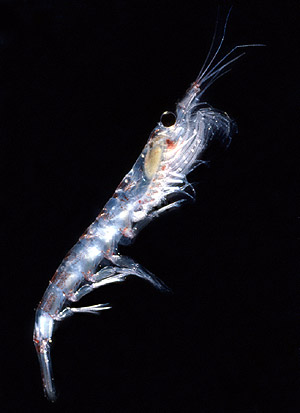
Antarctic Krill

More than anything else, krill are the engine that powers the Antarctic ecosystem.


They are a small semi-transparent crustacean like a shrimp, about 4-5 cm (2") in length when fully grown, they can live for up to 6 years which is quite remarkable considering the wide variety of animals that feed on them in huge quantities. Krill belong to the animals that make up the zooplankton. The "zoo" means that they are animals, the "plankton" means that they float in the upper reaches of the water column and are at the mercy of the ocean currents, being able to change their position in the water column, but not able to swim against the current or migrate in the normal sense.

Krill feed on microscopic phytoplankton ("phyto" - plant) that are extremely abundant in Antarctic waters due to the great upwellings of deep waters at the Antarctic convergence. These upwellings bring with them great amounts of dissolved nutrients, especially nitrate and phosphate that fertilize the microscopic but hugely abundant phytoplankton in the same way that a farmer puts fertiliser on the fields. Add to this the 24 hour intense sunlight of the summer months and the scene is set for a super-abundance of life.
Krill are unusual in that they are so super-abundant and large when compared to other phytoplankton feeders in other oceans. This means that many large animals such as seals, penguins, whales and myriad birds are able to tap the food chain close to the production of the phytoplankton before energy is lost, so the Antarctic supports a large population of large animals.
Krill rise and fall in the water column depending on the time of day, they drift around in swarms that are so large it difficult to imagine, so they are either not in a particular area at all or are present in unimaginably huge quantities. Swarms estimated at containing 2 million tons of krill spreading over more than 450 square kilometres have been observed. This is the equivalent of 28.5 million human beings, 4 times the population of Greater London or approximately the entire population of Canada, averaging 70kg each, in area a third that of Greater London. The krill population of the world has been estimated at outweighing the human population of the world
There is a very complex ecology that has arisen involving krill and krill predators, with different species of predator feeding at different times of year at different depths and on different sizes and therefore age groups of krill. Despite the apparent ever present seemingly overwhelming presence of predators, krill can manage a lifespan of up to seven years.
There have been attempts to catch krill commercially and great factory ships have been sent down to the Antarctic by some nations to catch and can krill quickly. Fortunately for the krill and the Antarctic ecosystem , krill go off very quickly after being caught, the Antarctic is a long way away and consumer interest remains fairly low (krill aren't very nice for people to eat!). Krill is harvested by the Japanese (and a small amount by Russia) at around 100,000 tonnes per annum.
The most effective way of catching krill so far devised are the great baleen plates of baleen whales, such as Blues, Rights, and Fin whales. These  baleen plates made of the original "whalebone" (actually keratin, the same stuff that hair, fingernails and rhinoceros horns are made from) hanging in two rows from the roof of the baleen whales mouth. The whale skull has an upper jaw that is a long straight rod sticking straight out from the "brain case" up to 10-12ft (3-3.5m) or more long. The baleen plates make a sort of triangular "tent" the floor of the tent is the lower jaw and the large tongue is inside (the tongue of a large blue whale can weigh as much as an adult bull elephant). The baleen whale takes a large mouthful of sea water and krill with its mouth open, it closes its mouth and then forces excess water out with its tongue. The baleen plates are filters that let out water and small plankton but retain the larger plankton such as krill which are then swallowed.
Different whales feed at different depths and their filters are arranged slightly differently so they do not all compete for the same sized krill.
One way of feeding by some of the larger baleen whales is "bubble netting". The whale, or sometimes two working in a pair, dive down below a dispersed krill swarm. They then swim upwards in a spiral blowing air bubbles as they go. The bubbles cause the krill to panic and swim inwards so concentrating them into a smaller space. The whale then swims directly up through the middle with mouth wide open taking in a huge mouthful of krill and water that the baleen plates then filter.
Krill shortages


Recent studies (November 2004) have shown that stocks of krill in Antarctica have declined dramatically in recent years. The reason for this is likely to be a fall in the amount of sea ice in the winter months particularly in the Antarctic Peninsula region.
Krill numbers may have dropped by as much as 80% since the 1970's - so today's stocks are a mere 1/5th of what they were only 30 years ago. The decline in krill may  in turn account for the decline in the numbers of some penguin species.
Dr Angus Atkinson from British Antarctic Survey, says: "This is the first time that we have understood the full scale of this decline. Krill feed on the algae found under the surface of the sea-ice, which acts as a kind of 'nursery'.
The Antarctic Peninsula, a key breeding ground for the krill, is one of the places in the world where there has been the greatest rise in temperatures due to global warming. This region has warmed by 2.5°C in the last 50 years (much more than  the mean global rate), with a striking consequential decrease in winter sea-ice cover.
"We don't fully understand how the loss of sea-ice here is connected to the warming, but we believe that it could be behind the decline in krill."
There are commercial implications as well as scientific ones. The Southern Ocean is a valuable fisheries resource, many of the species caught feed on krill. Thousands of tourists are also attracted to Antarctica to enjoy the spectacular wildlife, most of which feed on krill.
There has been previous speculation that krill stocks might have decreased, based on smaller more localized surveys over shorter time periods. This new finding comes from data from nine countries working in Antarctica who pooled their separate data covering 40 Antarctic summers, in the period between 1926 and 2003. This is the first time such a large-scale view of change across the Southern Ocean has been seen.

Another animal that feeds on the same phytoplankton food as krill, jelly-like colonial animals called salps that drift in the ocean currents have increased in the same time the krill have decreased.

This decline in krill will also make it more difficult for the great baleen whales to return to pre-exploitation levels following their decimation in numbers during the years from approximately 1925-1975.

Phytoplankton - plant plankton
Read more...

The Antarctic skua

1/ What are skuas like?


The Antarctic skua (Catharacta maccormicki) is the size of a largish gull. They nest all around continental Antarctica and breed into the deep south. They are excellent fliers and have occasionally been sighted deep in the interior hundreds of miles from anything other than ice. One of their feeding techniques is to chase and bully other birds into regurgitating the contents of their crop, a strategy successful with some species that are in themselves excellent fliers. They tend to have a reputation as being fierce and aggressive birds, which is somewhat unfair. I see them more as characters who stick up for their own corner and look after their own - no more or less than humans do.
Often a visitors first sight of a skua is at a penguin colony where they usually are nesting nearby. They hang around as a dark presence looking for unguarded eggs or weak or isolated chicks to prey on, which is a very productive means of finding food, but does their reputations no good at all.

2/ What is this skua doing?


This is a displaying skua. They display to, or for a mate or to other skuas to establish their territory. Sometimes the birds can be seen to do this as a pair, it is quite an impressive sight and the squawking can be heard some considerable distance away. Skuas will also do this if their nest is being approached by an unwanted visitor.  More often though the first sign that a visitor gets of being near to a skuas nest is of a sudden heart-stopping rush of air through the wing feathers of the parent bird flying at speed past your head from behind, much too close for comfort. If you're particularly unlucky or if its very unhappy at you being so close, then rarely a whack at the back of the head by the front of the wing may result. This is actually quite a good way of finding skua chicks - when the parents start getting upset you know you're very close to the excellently camouflaged chick.
This bird however was semi-tame and was calling to his mate to come quick as there may well be some give-away food. The biggest problem I had taking this shot was getting the bird far enough away as he kept sticking his beak about 10cm from my lens.

3/ What are these skuas doing?
These birds are on the specially made skua landing platform (also used by occasional Dominican gulls and sheathbills) outside the kitchen window of the scientific station on Signy island in the South Orkneys. There were two pairs of skuas that used it regularly (never at the same time though), the "Reds" and the "Blues" they lived respectively to the sides of the platform of their colours. This is Mr. and Mrs. Blue. Their nest was about 250m away downhill of this rooftop platform and occasionally when feeling lazy, they would walk up rather than fly and then glide downhill back home. If you were out nearby they would sometimes come to see if they could get any free food (see above) squawking and hovering above you. If you lent over forwards, then sometimes one would land on your back and look quizzically sideways at you as if to say "Now what?". I also had one of them once try to land on my back-pack as I was walking along. Unfortunately it was a purpose made back pack that consisted of a frame with two large open top cans attached. The first I knew what was happening was when Mrs. Blue fell into one and with much scrabbling and panic managed to get out of it before settling nearby and giving me a haughty stare.

4/ What kind of birds are these?
This is a Cape pigeon or Pintado a pigeon sized petrel common around sub Antarctic islands and peninsula. They nest on rocky ledges and usually rear a single chick which looks particularly shape-less until it fledges. It used to remind me of a fluffy ball with a head just stuck on the front. The birds tend to feed in flocks on krill and small fish but also will scavenge on scraps discarded by skuas and giant petrels when feasting on floating seal carcasses.
5/  Are these the same bird?
These are sheathbills (also sometimes referred to as "Mutts" - it just seems appropriate) and they're the "dust men" (garbage disposers) of the Antarctic. They will eat just about anything that they can lay their beaks on, the one in the lower picture had been feeding on (in) a dead seal. They frequently scavenge penguin colonies for eggs, dead chicks, even penguin faeces - there's occasionally some not fully digested food there. The only Antarctic bird species that don't have webbed feet and so are not able to fish for food like the others. They usually stay out of the path of the sea-ice and move north in the winter when the worst weather comes. The top picture however was taken in mid-winter at a temperature of minus 30 centigrade of one of a small colony of sheathbills that lived around the base on Signy island. Whereas most of the other sheathbills would move north, this hardy group evidently thought that there were enough scraps available from the base to make staying worthwhile. Surprisingly hardy creatures, the bird in the picture has its feathers fluffed out as far as it can and is considerably skinnier than this picture shows.
In an attempt to try to reduce heat loss mutts will hop around on one leg rather than risk getting two cold. This made landing rather exciting as they found out the hard way that this is really a two legged activity. Frequent falls down small holes were another hazard as their one leg went between slats on wooden decking. In fact so determined were they to not use both legs and so clumsy in the process, that for a while I was convinced that there were actually several unfortunate individuals that really only had a single leg, as they would hop away rather frenziedly if they were in your path rather than put the other leg down or fly.

6/ Sheathbills - waiting for kitchen scraps
Sheathbills "Mutts" waiting outside the kitchen window in winter. With no skuas around in the winter months, these birds that live around an Antarctic scientific base can actually get to the best supply of food around at this time. They accumulate around meal times drawn to the smells coming from the kitchen waiting for the "gashman" to start clearing up and hopefully throw some tasty morsels in their direction. Not exactly a good looking bird and very nervous and skittish as befits a small and vulnerable creature that makes its living by scavenging, it was difficult not to have some respect at least for Mutts as they braved the harshest of conditions and seemed to know their place in the hierarchy - right down at the bottom.

7/ Why does this bird suddenly dive bomb?


Antarctic terns nest on the Antarctic peninsula and also particularly on antarctic islands. It lays it's eggs in small quite widely spread out colonies, i.e. low density of birds in the colony. The nests are made on the ground in places that tend to be isolated but quite exposed. The eggs and the chicks are excellently camouflaged and the birds defend them from a distance so as not to draw attention to where the nest is.  The upper picture shows a tern hovering at the "nervous" stage when its nest is being approached maybe by a skua or other scavenger. Once the intruder gets too close for comfort then it dive-bombs as in the lower picture. No apologies for a lack of sharpness in this picture, this is exactly what it seems like. The term dives and builds up great speed before letting out an ear-piercing call that is perfectly timed to cause maximum panic and consternation. No matter how prepared you think you are, the first "attack" feels like it's removed some time from your life.
Terns feed on small fish and plankton, such as the ubiquitous krill
Read more...

Whales in Antarctica

Whales are amongst the most enigmatic and fascinating of all creatures. The Blue Whale is the largest animal ever to have lived on earth, at up to 100 tons, easily out-weighing the heaviest dinosaurs, even an "ordinary " sized whale is a vast and impressive creature.


Killer whale or Orca looking around having broken thin ice for a breathing hole, picture courtesy NOAAWhales are huge, but elusive and difficult to see which adds to their mystery and fascination. They are highly intelligent animals with an elaborate social life, no possessions and the complete freedom of movement in three dimensions. Is it any wonder that they are such popular and fascinating animals? - maybe we just want to be like them!
Whales belong to the group of mammals called Cetaceans, they are a part of this group along with dolphins and porpoises.
Whales are mammals as are humans, dogs, cats, elephants and anguantibos amongst others. This means that they are not fish. They breath air and so must return to the surface at regular intervals to get a breath. They give birth to live young that stay with the mother for over a year and feed on milk produced by the mother.
Whales are warm blooded and have a skeleton similar to our own (though greatly modified) the fore limbs are their front flippers and have similar bones in them to our arms and hands. The hind-limbs are generally not present at all, though are represented in many species by a tiny pair of "free floating" bones (pelvic vestiges) - not attached to any others - towards the rear of the animal. In the males of some species these bones serve as an insertion for the muscles that control the penis.
Skeleton of a Right WhaleThe rear flippers of a whale are called the flukes, these have no bone in them at all, being made of tough fibrous material. It is the flukes that provide the propulsive power in all Cetaceans with the forelimbs controlling direction and being used for communicative and social functions.
All whales have muscle with a high level of Myoglobin. This is a red pigment similar to haemoglobin that stores oxygen in the muscles for use during deep dives. When the whale surfaces, the oxygen in the myoglobin is replaced, similar to the process that happens in our own muscles during a sprint.

Toothed whales or Baleen whales


Cetaceans are split into two groups, depending on whether they have teeth or not.

Toothed whales - Odontoceti

This group includes Dolphins, Porpoises, Killer whales (Orcas) and Sperm Whales. They have teeth in the usual manner, usually consisting of lots of identical peg-like (but often very sharp!) teeth to catch their slippery prey. Odontocetes are predators on fish or other fast swimming and fairly large prey such as squid. Toothed whales differ from baleen whales (and every other mammal) in that they only have one nostril instead of two.
Juvenile Orca shows gnashers
A young Killer Whale - Orca showing teeth. Orcas have teeth in both jaws like most Odontoceti, Sperm Whales are unusual in that they only have teeth in the lower jaw.

Baleen Whales - Mysticeti

The members of this group don't have teeth as we know them, but baleen plates  or "whalebone". The whole skull of such whales is highly modified. There is a large strong bony projection from the front of the "brain case" from which baleen plates (made of keratin, like skin, fingernails, hair, hooves and rhino horns) hang on either side. This makes a triangular tent-like structure that is a large and elaborate sieve. The lower jaw is the "floor" of this tent and baleen whales have a huge tongue that sits in the middle of it all.
Mysticetes take in a mouth full of sea water and huge numbers of planktonic food such as krill or even shoaling fish They then close their mouths and use the tongue to push out all of the water through the baleen filters which keep the small prey inside, these are then swallowed. Different species of whales feed on different sizes of prey according to how wide the gaps in their baleen filters are. In this way, they don't all compete directly with each other and so are able to co-exist in the oceans occupying different "niches".
Baleen whales have two rows of baleen plates and a large tongue.
A Right Whale, a baleen whale, showing the baleen in the mouth and the large tongue

The baleen whales include all the really large whales apart from the Sperm Whale (which has teeth). Blue, Right, Sei, Fin, Gray and Minke whales are all baleen whales.
Sometimes whales may be referred to as "Rorquals" These are members of a group of whales that are characterised by having numerous longitudinal grooves along the throat region, they also have short baleen plates, rarely more than 3 feet long and are the fastest swimming of the whales.
Taxonomy of whales
Taxonomy is the study of the relationships between organisms. It is a system of classifying them by observable structures that may be large, molecular or anywhere in between. Taxonomy groups organisms according to their similarities based on evolutionary relationships.
Whales are mammals of the order Cetacea:

This is not a comprehensive summary of the taxonomy of all Cetaceans, but of those found commonly in Antarctica and covered in more detail on this site.
It's always struck me how there's not that many pictures of whales around and the ones that there are often not really that clear. The reason for this is that it's very difficult to take a picture of something so large that lives in the water. It's not helped by the fact that whales while being very large are also pretty fast swimming and difficult to find in the vast expanses of ocean.
Their size means that you need to be quite a distance from the whale in order to take a picture, many waters are not that clear and by the time you're 100-150 feet away to get the whole whale in the picture, you just can't see it very well any more!
Open oceans tend to be clearer than coastal waters, but then there's the problem of finding the whales, once you know where they are you need to get to them, usually by boat which in the process will probably scare them away. Sure you can find and follow whales in fast boats like the whalers used to do, but the cost is to terrify the poor creature in the process and by the time you've jumped in the water to take some pictures, you've been left way behind and are now able only to swim at a snails pace compared to the full speed whale.
The final problem - though really part of the other two - is that no-one knows where whales spend much of the year. We know where they go to feed during seasonal abundances of foods when the problem is usually that the plankton in the water that is the reason for the whales being there make it difficult to see far under water, and a hungry whale swimming around feeding happily is a difficult thing to get near and get to pose for you.
The end result of all this is that good pictures of any whales are difficult to achieve and any pictures of some whales are almost impossible to achieve. So most of what there are tend to be of a few easier to photograph species such as Humpbacks and Orcas, or of bits of the whales as seen from the surface usually headed in the other direction.
Read more...

Animals in Antarctica

Adélie Penguin Basics
Average Weight: 5kg - 11lb - feels more than this though when you've upset one and it's ran up and attacked you by hanging off your thigh muscle with its beak, like 5 bags of sugar dangling from a pair of pliers attached to your leg.
Average Height: 70cm - 27.5inches


Breeding Season: November - February - Adélie penguin colonies are very loud, raucous, busy and smelly affairs. The call of an adélie is as musical and gentle as a braying jackass and the whole colony is awash with guano (posh word for bird poop). When I was in Antarctica one thing I did was help with long-term surveys which entailed walking through the colony (terribly frowned upon these days). Each nest is just over two pecking distances apart so the penguins can't reach each other. Of course walking through the middle meant that you were in range of everyone. I used to worry a lot about falling over in a penguin colony, covered from head to toe in guano and pecked mercilessly.
Reproduction: Large colonies of up to half a million birds. Nests are lined with pebbles, and slightly higher than the surrounding land so that if the temperature rises and the snow melts, the nest is not flooded. The males arrive first on the nesting site at the beginning of the season and start the nest, then both partners work on the nest. Usually two eggs are laid, rarely three. Incubation of the first egg is 35 - 37 days, and the second chick is a few days behind the first. Male and female parent share egg and chick duty. Chicks are fed regurgitated krill (yum!) The chicks become independent at about two months old.
Estimated world population: - 5 million breeding pairs
Distribution: Circumpolar, tend to be found within the pack ice.
Oldest Rookery - At least 6,335 years old. The places where penguins nest together are called rookeries. These are started and later abandoned for reasons that are not entirely clear. Archaeological type studies have found that these rookeries are often continually used for many hundreds of years, even thousands. The oldest so far found has been used every year since well before 4 000 BC.
Adélie penguins are scared of: Leopard seals - main predators of adult birds, and Skuas - prey on eggs and chicks on land. They are not scared of the "Ice Man", "The Thing" or falling over on their backs and not being able to get up again - the first Antarctic "Urban Myth".

1/ Adélie penguins live further south than any other type. Why are these on the ice?.
There are more Adélie penguins than any other penguin species. They live in the deep south and as such frequently have to cross many kilometres of ice still bound to the continent or islands to reach land in the spring where they can build their nests.


Sometimes they have to travel as much as 100 kilometres, though usually 20-40 is more usual. A long walk nevertheless.
This pair were early arrivals in spring at an Antarctic Island near the northern edge of their breeding range and only had about half a kilometre to waddle and "toboggan".
Tobogganing is a way of getting around where there is smooth snow or ice. The penguin lies on its stomach and propels itself along using its feet, an efficient use of energy and one where the penguin can easily keep up with a running man.
 2/ When do adélie penguins start to nest?
Adélies winter on the pack ice where the air temperature is higher than on land and where they can find cracks in the ice to fish through. In October, they begin to move south to their breeding grounds, the males arriving first to establish territories and nest spaces with the females arriving shortly afterwards. This is one of the first males arriving back in the spring before the remainder of the sea-ice has broken away.
3/ Why are these penguins hopping about on the ice?
These Adélies have a problem, they went out fishing at high tide and now. some hours later have returned. In the meantime the tide has gone out.   Still attached to the land is the "ice-foot" an ice step left behind as the tide rises and falls in the winter months to which the floating sea ice is loosely attached. When the sea ice breaks out, the ice-foot is left behind for a period of days to weeks before rising temperatures and the waves cause this to break off too.
What was a short hop down for the penguins is now a step too high for them. I spent a couple of hours one afternoon watching and following an ever increasing number of penguins as they came back from their fishing trip. They wandered up and down the shore-line trying to find somewhere to get up, but to no avail. Eventually, the tide came back in and so they floated back up to the right level and were able to get back to their nests. The ice-foot broke off completely a few days later in a mild storm.

4/ How long were they stuck?
More of the Adélies stuck at low tide.   The ice-foot is more evident in this picture and the number of penguins is building up, by the time the tide was rising enough to float the grounded "bergy bits" that the birds are standing on, there were about 50 or so penguins standing around before they could get back up.     
 

5/ Are there any problems in photographing penguins in these conditions?
This proved a difficult subject to capture on film.   A high contrast subject in bright light against a high contrast background poses an extreme problem in terms of exposure. The answer in this as in many other similar cases was to take an exposure reading off a neutral mid grey subject, set the camera for this and ignore anything the light meter told you when pointing at the real subject. After much experimentation, the ideal grey subject for metering turned out to be the pale grey moleskin  trousers that I wore (moleskin is a kind of thick warm cotton fabric, it's not really made from moles!). A very happy coincidence.

6/ Why is this penguin showing off?
What a handsome fellow! This male adélie is a bit late compared to the others around him who have in the main already paired and nested.   The males arrive at the breeding grounds first, find a good spot and then go through this display with much raucous calling and flipper waving to attract a suitably impressed female. (A similar ritual is re-enacted on Friday and Saturday evenings at bars and clubs the world over)
This shot also shows the half-feathered beak characteristic of Adélie and how stocky and powerful they are despite their diminutive stature. A friend I was with on a similar occasion was attacked by an unhappy adélie that had decided he was too close to the nest. My friend described it as "..like having 5kg of solid muscle hanging from your skin by a pair of pliers" - don't try this at home.

7/ Adelie penguins (Pygoscelis adeliae) tobogganing
Tobogganing Adelie penguins (and a lone chinstrap in the fore-ground). All types of penguin that come across snow and ice can and will toboggan in this manner. It is a very efficient and rapid way of moving when the conditions are right - soft snow, but where the penguin only sinks a little way into it, needing less energy than walking the same distance. The penguin lays on it's front and pushes its way forwards using its feet, the flippers are used for balance or sometimes as oars to help forwards movement. A considerable speed can be reached for short distances in this way, enough to out pace a running man.
8/ Penguin dive
Antarctic penguins run a constant risk when entering or leaving the water from the almost ever-present danger of their main predator, the leopard seal. Leopard seals tend not to chase penguins in open sea, but hang around the places where they jump into the sea from their nesting areas, or where they leave the sea again as this is gives much more productive hunting.
This gives the penguins a problem when going into the sea, they have to enter it to go fishing and to get places, but being the first one in means that they're first in line for any potential leopard seals. Hanging back isn't any better though as they may get left behind and end up jumping in on their own. What happens therefore is that they gather at the edge of the water becoming quite animated and jostling for position until one near to the edge gets pushed or jumps in - that's the signal for the rest, as the odds of survival are far greater when you're part of a large group, they then all dive in in rapid succession.

9/ Surprise! - where did you come from?
These penguins were walking, waddling and tobogganing up and down the area beneath the ice foot looking somewhere to get out. So I thought I'd play a little trick, squat down out of view and wait for them to turn the corner - no I didn't jump up and shout "surprise!", but the comic effect of the first bird's reaction to realising he was coming towards me at high speed is evident.
Fortunately I managed to get this shot off and capture the moment before moving sea-wards (to the left) and allowing their progress to continue, they were back again a few minutes later though as all they could really do was wait for the tide to come in and raise them up to the right level.
10/ Is this a penguin? Wait until his father gets home!
When the parents go off to sea to catch fish for the chicks, the chicks have little to do other than stand around and try not to get into trouble.  This doesn't always work in the way that it is supposed to, rather like human children, penguin chicks fall over sometimes and get a bit dirty!


1/ What are Weddell seals like?
Weddell seals are animals of the ice. They live further south than any other mammal. Between the end of August and early November in the southern hemisphere spring, the mother seals to be haul themselves out of holes in the ice and give birth to their pups. When born, Weddell seal pups look like unstuffed pyjama cases, all skin and flippers and not much content. Over the next few weeks the change in mother and pup is like one balloon deflating and filling up another.
Weddell seals are animals of the ice.

2/ How do Weddell mothers look after their young?
Newly born Weddell seal pups have to be some of the worlds cutest creatures as they flop about the ice in the early days after their birth, not able to co-ordinate their over-sized flippers before they grow into them.   The mother arrives pregnant and with enough resources of blubber and protein to double the 25kg (55lb) birth weight of a pup in 10 days. She doesn't feed for about the first month and goes from an extremely plump barrel shape just before she gives birth - to a skinny shadow of her former self with ribs visible while the pup reverses the process.

3/ Isn't it difficult for the pups to survive when they're born onto the ice?
Weddell seal milk is one of the richest produced by any mammal. It contains about 60% fat (go and compare that to the label on the milk carton in the fridge) and it is this that is responsible for the rapid weight gain made by pups shortly after birth.   The pups are weaned (stop drinking milk and begin eating normal seal food, i.e. fish) at around 7 weeks when they should have reached about 110kg (242lb). When adult, they will weigh up to 400kg (880lb) and be up to 3m (10ft) long. Unusually, the males are slightly smaller than the females.
Pups are encouraged into the water very early on by their mothers, perhaps only a week or so after birth. The water is their natural habitat and with their thick protection of blubber is a more comfortable place to be most of the time for these seals than out on the ice where the temperature can be -40° C or less with winds frequently of gale force or greater.
4/ Why do they have such large eyes?
Weddell seals live on the edge of the ice all year round and dive down beneath it to feed. When underwater there is frequently little light, particularly if there is a layer of snow over the ice which can make it very dark indeed. The seals therefore need good vision to catch their food.
5/ Where are the males when the pups are born and suckling from the mother?
Weddell seals usually have their pups on sea-ice, getting in and out of the sea through a breathing hole. These breathing holes are guarded and kept open by the males during the time when the females give birth.   The male guarding the hole will defend a territory beneath the ice against other males for access to mates. The females are ready to breed again shortly after the birth of the pup so the males that successfully defend a breathing hole will mate with the mother seals that use this hole, typically this will be a ratio of about 10 to one.
6/ How do Weddell seals manage to survive out on the open ice? How do they get to the sea?
Weddell seals prefer to live on ice that is broken up somewhat, in this way there are often natural cracks and holes through the ice that they can use to get in and out of the sea. There are also holes and cracks around ice bergs that are trapped in sea-ice and often "tide-cracks" appear near when near land, all of these help.These holes are fine to begin with, but when temperatures are well below freezing, they begin to freeze up - quickly. The seals keep the holes open by rasping them with their teeth. They open their mouths wide and move their heads back and forward in a wide arc attacking the ice that is building up around the sides of the hole. This is a very fast and vigorous process that takes a lot of energy and a toll on the seals teeth.
Keeping breathing holes open like this wears away the teeth of Weddell seals and it is this that means that the Weddells only live to about 18 years old, about half the life-span of a crabeater seal for instance.
Weddells can swim great distances across apparently continuous sea-ice by detecting the natural cracks and holes along the way. When covering distance rather than fishing, they only dive to a shallow depth and find the next breathing hole in the gloom under the ice by sonar - they emit a series of high pitched sounds and pick up the difference in sound when the sounds reach a hole.

7/ Do the pups take naturally to the water straight away?
The first picture is of a juvenile Weddell seal  weaned from its mother about 2 or 3 months previously and already completely in control in its aquatic environment.   The scene a few months ago was rather different though. Weddell seal pups don't automatically realise that they can or should dive and the early attempts are amusing to watch.
"Attempts" is the wrong word. What actually happens is that the mother pushes the pup into the water against its will. She then pushes its head under the water - again against its will. There is much coughing, spluttering and panic before the pup realises that it can hold its breath under the water and that this in fact does help!
The pups soon get the hang of it though and as adults will dive to up to 600 metres (2 000ft) or more staying under for up to an hour and going as much as 12 kilometres from the breathing hole.
A typical feeding dive takes the seal to 200-400m and lasts for 5-25 minutes.

8/ Weddell Seal (Leptonychotes wedelli) at breathing holes
Weddell seals are very hardy, resourceful and quite remarkably behaviourally adapted for life in the Antarctic pack and fast-ice as these two pictures show. In the top picture, the seal has found a breathing hole through pieces of only partially consolidated pack-ice where there is a non-frozen portion that is nonetheless filled with slush. From below such a region will let considerably more light through than the thick pack-ice pieces and stand out like a beacon to a seal swimming by, even if it is solid, it will be thin and probably thin enough for the seal to break through. Weddell seals have no land-based predators and so there is no danger to them of coming up to such breathing holes, just the odd surprise if there's a wandering scientist nearby to capture the moment on camera.
The lower picture is of a Weddell seal that has made a hole in apparently unbroken, though quite thin fast-ice and hauled out for a rest. We came across this seal while out several miles from the shore on recently formed and very hard and strong, but disconcertingly thin ice. In fact we didn't realise how thin the ice was until we came across this seal and the hole it had made. It was entirely unperturbed by a group of 5 people manhauling a heavily laden sledge with camping gear as we went off on our holidays and treated us as if we weren't really there at all. Seals probably live a fairly surreal life anyhow.

9/ Why are the White Island Weddell seals special?
White Island from McMurdoWhite Island is an Island in the Ross sea that has the most southerly population of Weddell seals. These seals are only 1 300 kilometres from the South Pole, but this is not the only remarkable thing about them.
They are isolated from the rest of the world as the nearest open sea for them to is too far under the very thick ice of the Ross ice shelf for them to get out.
These seals are thought to have travelled to this area between 50 and 100 years ago when a large chunk of permanent ice shelf broke off. They were then trapped when it reformed behind them and have remained here ever since. They use cracks in the ice immediately beside White Island to reach the sea, they must dive about 70 metres here through cracks in the ice before they get down to the open sea below. In the summer when the sea ice has broken up, it is still at least 22 kilometres to the next breath at the edge of the ice shelf, too far for the seals to manage.
So here they remain unable to leave the area and with a deep dive past walls of ice before they can even begin fishing.
Read more...
 
.::Environment & Climate Change::. © 2011 DheTemplate.com & Main Blogger. Supported by Makeityourring Diamond Engagement Rings

You can add link or short description here