Advertise

Advertisement

Search This Blog

 
Showing posts with label Travel. Show all posts

Walking Into the Stone Ag

On the third day of an international conference in France of experts on prehistoric rock art, National Geographic Digital Media senior producer Andrew Howley makes his first visit into caves adorned with images painted 13,000 years ago.

By Andrew Howley
Tarascon-sur-Ariège, France--Today the laptops were shut and the projectors powered down, as the participants in the IFRAO conference on prehistoric rock art around the world piled into buses with people who shared their language for tours of some of the region's most beautiful and important decorated caves. I was with Group 4: English-speaking and headed for Bédeilhac and Niaux.
Bedeilhac-exterior.jpg
The grand entrance to Bédeilhac, one-time warplane repair shop.
Photo by Andrew Howley
Bédeilhac was first, an enormous cavern used during World War II as a plane repair shop, and in the 1970s for a film where a small plane was actually flown into and out of the grand entryway. Walking 300 meters inside, you begin to reach the untouched prehistoric area, and are treated to a stately black bison silhouette, hard-to-reach engravings, and a replica of the even-harder-to-reach molded clay bison, one of only a few such sculpted images from the region.
Bedeilhac-interior.jpg
It doesn't take too long before modern usage of the cave seems a thing of the past, and you're gazing directly into the the Paleolithic era.
Photo by Andrew Howley
After a quick lunch of leftovers and a box of the local vintage, we headed up to Niaux, the grandest of the decorated caves in Ariège.
While some caves have been found in modern times, like Lascaux (discovered 70 years ago this coming Sunday), and many are still waiting to be found, Niaux, with its relatively easy entry way and wide caverns, has been known throughout history. This fact is illustrated, quite literally, by rock art of another kind.
Names of visitors and dates of visits cover several sections of the caverns (though they've been removed from where they were close to the prehistoric images). Some date from as recently as 2008. Others are verifiably from the 1600s. Still others claim to date from 1304 (no chance, based on the handwriting style) or to have been written by a first-century Jewish man by the name of Jesus. Perhaps you've heard of him?
Niaux-view.jpg
The entry to Niaux commands a view of the valley below and of the Pyrenees rising to every side and ascending to rocky peaks in the distance.
Photo by Andrew Howley
So if people have been visiting the caves for at least the past 400 years, you may be wondering if they made any mention of seeing the prehistoric art. The answer is yes. And no. These early modern visitors did record their experiences and described the caves as having images of "horses and cows," but they seem to have had no awareness of the deep antiquity of the images' creation. It's a testament to the timelessness of these works from such a distinct time.
Cathedral in the mountain
After walking for a while longer, we reached the greatest section of paintings in Niaux, the Salon Noir. As we entered the great "cathedral in the mountain," we turned off our flashlights and our way was lit only by the lights controlled by our guide.
This increase in darkness (while exciting and atmospheric) is done as a precaution against changing the natural temperature and lighting conditions of the cave system too much. For decades, Niaux's tour programs have been strictly guided by scientists' recommendations for the number of people, duration of each visit, and number of visits per day, and it has helped keep the paintings in a very good state of preservation.
Lascaux famously suffered greatly from changes in humidity and temperature from years of unrestricted visits and elaborate but ultimately detrimental attempts at air conditioning. That cave is itself closed to all but a few now, while workers fight off a pervasive image-covering fungus. Visitors are welcomed at a full-scale replica cave called Lascaux II.
800px-Niaux,_bisons.JPG
Copy of a painting of bison in the "Salon Noire" of the Cave of Niaux.
Photo from Wikimedia
In the gloom of a single light, we followed our guide to the first panel, where she pointed out the outlines of two bison. One (bearing a striking resemblance to an animal-cracker bison) is in fact the oldest painting in the cave, carbon dated to 13,850 years ago. To put that in perspective, if one day at noon you started thinking through 16 years every minute, you'd hit Jamestown in about 15 minutes and ancient Rome around 2pm. Stonehenge would go up around 5pm, and you wouldn't see this bison being painted until almost 2am the next day.
The lights went out and came back on as the first major panel was revealed. Here there were bison and horses, big and small, overlapping, facing each other, some complete, others partial, and all of it eye-openingly fresh and clear.
"After years of seeing images like this in books ... seeing them bright and bold and on their original cool, hard, wildly undulating surface was exhilarating."
After years of seeing images like this in books and two full days of seeing them projected on sun-blanched outdoor screens, seeing them bright and bold and on their original cool, hard, wildly undulating surface was exhilarating.
In the Internet era, we see images constantly. Big and small, hi-resolution, 3-D modeled, and so on. But the blessing is also a curse. Images now can be seen anywhere, but they don't actually exist anywhere.
In Niaux, these bison, horses, and ibex are most definitely existing. This is where they were made, this is where they've been for 13,000 years, and this is where they will be tomorrow and 13,000 years from now.
We processed around the large semi-circular Salon Noir, alternating between moments of quiet observation and reflection, excited pointing and questioning, and even in the depths of the cave, scholarly debate. My two favorite points of contention today: Can you say that some of the paintings are "better" than others? and can you tell whether any two were made by the same person?
After that, we made our way back out into daylight and the bright orange bus that would take us back to our home base.
What were they thinking?
Among all the various ideas that bounced around today, there was still the recurring theme that we'll never really know exactly what the makers of prehistoric rock art were thinking, but we can be pretty sure that there is no one simple explanation or answer. These images, and the experiences of making or seeing them can have many meanings at different levels at the same time.
My favorite illustration of this came shortly after we entered Niaux, and our guide pointed out the much smaller entry tunnel that the Paleolithic people had used.
Picturing a group of people in handmade leather garments softly stepping along a sandy floor across the gallery from where we were processing with our flashlights and hiking boots, I said to my neighbor: "I was just thinking how here we are now, and this is where the people of the past really were, and it's almost like it's all happening at once, and while they're the people of the past to us, we're the people of the future to them..."
"While you're having those thoughts," he replied, "I'm singing "Heigh-ho, heigh-ho.""
I whistled along and we continued deeper into the cave.
Earlier blog posts in this series:
Andrew Howley photo 2.jpg
Andrew Howley is a senior producer for National Geographic Digital Media, responsible for editing theNational Geographic website home page and the front page of National Geographic Daily News. He also manages the National Geographic Facebook page, which has more than 1,700,000 followers. Prior to joining National Geographic, Andrew was a programming manager at America Online, which included writing promotions for the Welcome Screen. He received a BA in Anthropology (focus on Archaeology) from the College of William & Mary, Virginia. His personal interests are history reading, painting, running, and developing educational projects.
Join Nat Geo News Watch community
Readers are encouraged to comment on this and other posts--and to share similar stories, photos and links--on the Nat Geo News Watch Facebook page. You must sign up to be a member of Facebook and a fan of the blog page to do this.
Read more...

Chicago’s Great Culinary Middle Ground


PAUL KAHAN is one of Chicago’s best chefs, and his restaurants are reliable bellwethers for what’s going on in the city’s dining scene. When Blackbird, his first restaurant, opened 12 years ago, it presaged Chicago’s rebirth as one of the planet’s most dynamic restaurant cities — a promise fulfilled by restaurants like Alinea, Schwa and L20. Mr. Kahan followed Blackbird with Avec and the Publican, restaurants that are less formal, better suited to a city that needed less pomp and polish to go with good food.
A few weeks ago, Mr. Kahan opened a fourth restaurant, Big Star Taqueria and Bar, in what was once a mechanic’s garage. There’s country on the jukebox and a complement of tequila behind the bar, but the real draw is the tacos, including spit-roasted al pastor, which go for $2 apiece.
The extremes have long been the best places to eat in Chicago: the city is home to some of the world’s finest temples of haute gastronomy as well as its greatest collection of hot dog stands. But the middle ground — the world between the direct pleasure of a salty, snappy dog and the epic degustation menus at the city’s fanciest restaurants — has been a notable absence.
No more. In the past few years, a number of chefs and restaurateurs have taken on everyday foods, revisiting, revising and approaching them with care and, often, a twist or two.
Big Star isn’t the only news in the Mexican scene in Chicago; Rick Bayless — whose Topolobampo and Frontera Grill have reigned over the Chicago Mexican scene for 20 years — has just opened a third spot. He, too, went for the middle, opening Xoco (pronounced SHO-ko), a torta, soup and churros place that is primarily a lunch destination. The menu tops out at $12.50.
“I didn’t want to do tacos — we do those in Frontera,” Mr. Bayless said in a recent interview. “I wanted to bring street food flavors inside and offer them at a price point for other people that can’t afford to come to the other restaurants.”

Xoco has a casual vibe, like a cheerier, more colorful Chipotle Grill. A quick scan of the menu, though, makes it clear that there’s more to Xoco than meets the eye: there are headcheese tortas, drip coffee brewed to order and served in handsome glass Chemex pots, and a half-dozen more farm names than you usually encounter on a chain restaurant’s menu.
Tortas, Mexican sandwiches, are the specialty at lunch, and the selections cooked in the restaurant’s wood-burning oven are your best bet (the griddle-cooked tortas were too cheese-driven for me, though if a grilled cheese is what you’re shopping for, the griddle is the way to go). The pepito — an assemblage of short ribs, black beans, caramelized onions and pickled jalapeños — is as good as its ingredient list reads, with bread toasted to a wonderful crispness by the oven. The woodland mushroom torta is no mere concession to vegetarians; Mr. Bayless’s decades of mastering Mexican flavors have somehow imbued him with the power to turn a goat cheese, mushroom and arugula sandwich into a bold Mexican sandwich. (Maybe the secret is the three-chili salsa.)


Tortas are available after 11 a.m., and they come off the menu at 3 p.m. to make way for Mexican soups. But the restaurant actually opens at 7 a.m., serving a phenomenal rendition of a combination of foods I first learned about from the title of a Spanish-language textbook I read in the sixth grade: churros y chocolate. The churros are crisp and fresh, dense in the traditional fashion, rolled in a dirty snowfall of cinnamon sugar and served warm. The hot chocolate features freshly ground cacao beans, and the drinks are predictably killer. The Barcelona, one of Xoco’s options, is so thick you can stand your spoon up in it, and so rich with bittersweet chocolate flavor it could do double duty as a dessert.
It’s not just Mexican fare that’s getting pulled out into the spotlight: Michael Kornick, the chef of MK, which twice has been awarded three stars from The Chicago Sun-Times since it opened in 1998, recently opened DMK Burger Bar, where he is serving grass-fed beef, truffle fries and house-made sodas, including blood orange and cherry.
But it is Kuma’s Corner, which Matt Cain opened four years ago on the North Side, that has been attracting the most attention of late. It is notorious for the wait to get in (long; no reservations accepted), the music it plays (heavy metal), the bourbon on tap (um, bourbon on tap) and, most of all, its burgers.
The night I visited, the hostess — tattooed and pierced — was direct and chipper about the 60- to 90-minute wait. (On a Monday night, I should add.) She added my name to her list; my younger brother noticed that next to each name is a description to help her differentiate customers; I was “scruffy, odd.” Fair enough.
I DON’T know what I was expecting — guns? outlaw bikers? — but the restaurant, with its high ceilings and a pleasing corner location, didn’t end up all that threatening. Sure, there were drawings of half-naked female vampires on the walls, a scrawl reading “Die Emo Die” above the bar, and the incessant and propulsive fluttering of double-kick bass drums chugging under growled vocals on the sound system all night, but my girlfriend’s parents — not the target demographic, one assumes — described it afterward as “a hoot.”
And the burgers are good. Big 10-ounce patties are grilled reliably to temperature and served on soft pretzel buns. The buns aren’t chewy or intrusive, but they are strong enough to keep the burgers, however wildly they are dressed, together, and they add an alkaline tang that complements the beefiness of the burgers.
There are 20 or so options for topping combinations, most named after metal bands, each progressively crazier. The most popular and probably the best is the Kuma Burger: a fried egg, bacon and Cheddar. I am typically averse to such profligate assemblages, but there’s something special about Kuma’s particular combinations — not harmonious, exactly, more like the often cacophonous sounds of the heavy metal that fills the room, channeled into burger form.
For an atmosphere as quiet as Kuma’s is loud, head to Great Lake in Edgewater, on the far North Side. Lydia Esparza and Nick Lessins opened the place last year in a tiny space with a homey feel — a mishmash of modern furniture, a few seats and a set of shelves where they sell an assortment of products they like, including wooden knitting needles. (Mrs. Esparza designed showrooms for Herman Miller before plunging into Great Lake; Mr. Lessins worked in consulting.) Mrs. Esparza said that Mr. Lessins had been working on a pizza recipe at home for years and, at a certain point, the couple decided it was time to bring it to the people. The transition from unseasoned home cook to restaurant chef has, I contend, never gone as well for anyone as it has for Mr. Lessins. This summer, Alan Richman, the food writer for GQ, called the mortadella pie the best pizza in the country. Having not visited quite as many pizzerias as Mr. Richman, I can only say that Great Lake’s pies are the best pizzas I have ever eaten in my entire life.
They hew to no traditional style — neither Neapolitan nor Chicagoan nor New York. But the crusts have a perfectly irregular crumb, pleasing but not overly chewy, with a yeasty tang, and they are crisp enough to stand up to whatever Mr. Lessins tops them with. (Digression: Chicago pizza is commonly associated with the baked casserole that is deep-dish pizza, but the more prevalent style features a thin, cracker-crisp dough, cut into a grid, not wedges.)

The toppings at Great Lake are sourced with an aggressively local bent; Dante and Mona — two cheeses from the Wisconsin Sheep Dairy Cooperative — have supplanted pecorino and Parmesan, and the mozzarella is local and freshly made. Some of Mr. Lessins’s combinations look unappetizing on the menu and then turn out to be knee-weakeningly good. The heirloom squash and country ham combo, for example: razor-thin curls of squash baked into the cheese, with the ham (from Newsom’s, one of the country’s best purveyors) sliced prosciutto-thin and draped over the finished pie.
There are a few caveats: Great Lake has severely limited hours (Wednesday through Saturday at the moment, though Mrs. Esparza encourages diners to call ahead and see if they’ve changed), it is BYOB, the service can be profoundly slow (pizzas are baked to order, one at a time), and waits can be tremendous. None of these things would stop me from going back.
TOPPINGS
Prices are estimated for two people, not including taxes, tip or beverages.
Big Star Taqueria and Bar, 1531 North Damen Avenue; (773) 235-4039. Dinner, $15 to $18.
Xoco, 449 North Clark Street; (312) 334-3688; www.rickbayless.com/restaurants/xoco.html.
Lunch, $15.
Kuma’s Corner, 2900 West Belmont Avenue; (773) 604-8769; www.kumascorner.com. Dinner,
$12.
Great Lake, 1477 West Balmoral Avenue; (773) 334-9270. Dinner, $25. (Open Wednesday and Thursday 5 to 9 p.m. and Friday and Saturday,
5 to 10 p.m.)
Read more...

Europe Travel

Overview Germany

Brandenburg Gate, Berlin
Brandenburg Gate, Berlin © Berlin Tourist Office


As Germany moves forward into the 21st century, leaving behind a history of division and tyranny, it is a nation embracing its newfound liberalism and redefining a modern cultural identity. Yet even today, visitors to the country can't escape feeling profoundly moved by this country's past and the effects it still has on its people.


Situated in the heart of Europe and bordering nine other countries, Germany provides an ideal gateway to any tour of the subcontinent. Its land is wide and varied with turreted castles nestled below snow-capped mountains, lush river valleys, dark and mysterious forests and bustling medieval villages. This is the land of fairy tales, where farmland minstrels headed to Bremen to become musicians, where Sleeping Beauty was woken and Little Red Riding Hood ventured into the woods.


Germany's cities each have something unique to offer the visitor. Each year millions of litres of beer are consumed in Munich during the city's Oktoberfest, where locals and visitors discover true German revelry and 'gemutlichkeit' (a word the locals use to describe a comfortable, sociable environment). Berlin, while still recovering from some of the scars of division, contains many sights from the iconic Brandenburg Gate, to the path of the old Berlin Wall. The city's vibrant nightlife is still evocative of its height in the 1920s and 30s, as characterised by the songs of Marlene Dietrich, the theatre of Brecht and the Film Cabaret.


Discover the country that gave us Beethoven and Bauhaus, Goethe and Glühwein, Lager and Lederhosen - you won't be disappointed.

Berlin
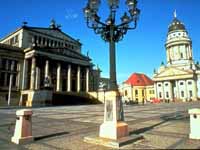
Academy Square, Berlin - State Theatre and French CathedralWhy?  People travel to Berlin mainly because of a fascination with the resurrection of this city, so long a pariah with its infamous wall which divided it after World War II, its dark period. There is little of the wall to be seen now, and the city is regaining its pre-war reputation as a centre of fun and frolics, the epitome of all that is good and great in German culture.

When?  Berlin is famed for its long, sunny summers (June to late August) so this is the best time for a Berlin holiday, when outdoor cafes in the parks and gardens (especially the Tiergarten) come alive with events.

Who for?  A holiday in Berlin is for the sophisticated fun-lover and culture vultures. Its famous cabarets and nightclubs are in full swing, and its opera and concert venues seldom miss a note. It is also a city of museums and memorials, grist to the mill of those who travel to Berlin for sightseeing.

More Info : Before you travel to Berlin plan your visit using our comprehensive, regularly-updated Berlin travel guide, which is a mine of information on where to eat, what to see and do, what weather to expect, how to use the public transport and a host of other useful facts and figures.For most of the latter part of the 20th century, Berlin has stood as a symbol of the division between East and West, split by the infamous fortified wall erected to separate the socialist sector from the democratic district. When the Berlin Wall was pulled down in 1990 the city discovered that it suddenly had two of everything, most notably two very distinct societies separated both socially and economically. The past decade has seen Berlin embracing unification and rebuilding itself as a modern European capital.

More than 100 streets have been reconnected, and signs of the Wall's existence have all but disappeared. Years of division are still reflected in the new city's architecture, however, with a modern city of skyscrapers, retail centres and urban developments in the West contrasting with most of the pre-War city that remains in the East.

For nearly 30 years the Wall sealed off the imposing Brandenburg Gate from the West, but now traffic passes through it freely. Similarly Alexanderplatz, which was one of the main centres of 1920s Berlin, and later post-war East Germany, has once again become one of the city's focal centres. The site of the infamous Check Point Charlie with its threatening monitoring tower erected to ensure no one crossed over from East to West, is now a museum, and while the tower no longer stands, visitors can see the East Side Gallery, a surviving chunk of the real Wall, now decorated by local artists.

Berlin is once again a vibrant centre for the arts, with many museums, galleries and theatres. At the Kulturforum visitors will find a number of impressive museums and concert venues from the spectacular Berliner Philharmonie concert hall to the complex's Picture Gallery, which houses a vast collection of European paintings from the 13th to 18th centuries.

Berlin still boasts a fantastic nightlife, and while tastes have changed since the height of the cabaret halls of the 1920s and 30s, there is a vast array of venues catering to all tastes. Berlin's calendar is also packed with festivals and parties from the Christopher Street Day gay and lesbian parade in June to the Jazz Fest Berlin in November.

Hamburg

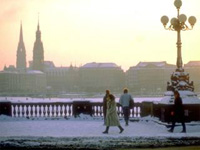
Winter in HamburgWhy?  Of all the cities in Germany, Hamburg is probably the most entertaining for a holiday, with plenty to see and do. Travel to Hamburg for world-class museums, wonderful art galleries, upbeat nightlife, excellent restaurants and first class shopping. Not to be missed during a holiday in Hamburg is a visit to the notorious Reeperbahn red-light district, a favourite haunt for tourists.

When?  High season for travel to Hamburg is during the summer months, but the disadvantage of a holiday in Hamburg during this period is that attractions are crowded and prices are at a premium. Summer weather is not particularly appealing for Hamburg is notoriously wet and windy most of the year. The most pleasant season weather-wise to holiday in Hamburg is spring.

Who for?  A Hamburg holiday offers something for everyone, from children who will revel in attractions like the world's largest model railway, to raucous groups of young travellers heading for the famous sex shows of the Reeperbahn, and everyone in between.

More Info:  Before heading for a holiday in Hamburg consult our helpful Hamburg travel guide, which lists attractions, events and excursions in the city as well as providing detailed basic information like entry requirements, currency and communications.Hamburg is a watery city, geographically, historically and atmospherically. It is Germany's second largest city and lies on the Elbe River, for centuries a major port and trading centre for central Europe. The city has a network of canals that rival those of Venice (it is said to have more bridges than Venice) and is centred on two artificial lakes that take up eight percent of its total area. Probably because of all the water, Hamburg is also known as Germany's 'green city', sporting 1,400 parks and gardens. Modern buildings sit cheek by jowl with historic Baroque and Renaissance architecture, and by night the neon lights dazzle all-night revellers, particularly in the city's notorious red light district, the Reeperbahn.

Hamburg was founded in 810 by Charlemagne and earned its place in history by becoming the most strategic port in the Hanseatic League of North German cities which controlled trade in the Baltic and North Seas between the 13th and 15th centuries. A great fire destroyed much of the city in 1842, and a century later World War II bombing raids again laid it waste, but Hamburg bounced back with style, thanks to the wealth garnered from its position as a trading centre. The city's tourist board claims that Hamburg is now home to more millionaires per capita than any other city in Europe.

Most of the sights of interest to tourists in the city are centred on its maritime traditions, particularly in the harbour area, where the 'Warehouse district' has been transformed into an entertaining destination offering several attractions. Further afield Hamburg is the gateway to the seaside and spa resorts of the Baltic and North Sea coastline.

Read more...
 
.::Environment & Climate Change::. © 2011 DheTemplate.com & Main Blogger. Supported by Makeityourring Diamond Engagement Rings

You can add link or short description here